The raison d'etre of this website is to provide you with hard scientific information which may help you make informed decisions in your quest for health (so far I have blogged concise summaries of over 1,500 scientific studies and have had three books published).
My research is mainly focused on the effects of cholesterol, saturated fat and statin drugs on health. If you know anyone who is worried about their cholesterol levels and heart disease, or has been told to take statin drugs you could send them a link to this website, and to my statin or cholesterol or heart disease books.
David Evans
Independent Health Researcher
Showing posts with label Cholesterol and the Immune System. Show all posts
Showing posts with label Cholesterol and the Immune System. Show all posts
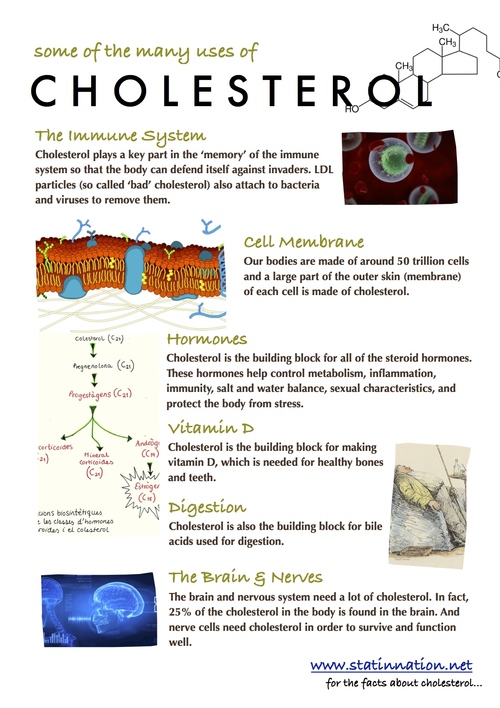
This fact sheet regarding cholesterol was created by Justin Smith of Statin Nation.
Justin says: "If we google 'cholesterol' of course we'll find thousands of images portraying it as "artery-clogging", but what about the real functions of cholesterol?
I have created this one page info sheet / poster in an attempt to re-educate about the many things cholesterol is actually used for within the body.
Please send this A4 sized image to anyone you think is afraid of their cholesterol.
Suggestions: -Print and use as a poster -Email / hand out to friends and colleagues -Fix to the front of your statin medication cupboard"
Justin has produced two DVD's that expose the $29billion cholesterol-lowering industry and explains how more than 40 million people have ended up taking a medication that is almost certainly causing them more harm than good.
Published in Med Hypotheses. 2006;66(6):1227-30. Epub 2006 Feb 24.
Hypocholesterolemia: a major risk factor for developing pulmonary tuberculosis?
Pérez-Guzmán C, Vargas MH.
Instituto Nacional de Enfermedades Respiratorias, México DF, Mexico.
Low cholesterol may be a major risk factor for tuberculosis because:
(a) cholesterol is an important molecule for the good functioning of an immune system, and is necessary for macrophages to uptake and engulf mycobacteria.
(b) tuberculous patients often have low cholesterol, in comparison with the general population and household contacts.
(c) cholesterol has a beneficial effect against pulmonary tuberculosis, since a cholesterol-rich diet accelerates the bacteriological sterilization of sputum.
(d) many conditions traditionally considered major risk factors for tuberculosis are accompanied by low cholesterol.
Pérez-Guzmán notes that cholesterol might be given to people with low cholesterol who are at high risk for developing pulmonary tuberculosis.
This post includes a summary of a study published in Clinical Immunology and Immunopathology 1997 Aug;84(2):145-9 and a recipe for roast chicken. Books:
Study title and authors:
Immune system differences in men with hypo- or hypercholesterolemia.
Muldoon MF, Marsland A, Flory JD, Rabin BS, Whiteside TL, Manuck SB.
Center for Clinical Pharmacology, University of Pittsburgh, Pennsylvania 15260, USA.
This paper can be accessed at:http://www.ncbi.nlm.nih.gov/pubmed/9245545 Lymphocytes are a type of white blood cell in the blood.
White blood cells help to protect the body against diseases and infections. T cells are a type of white blood that directs the body's
immune system to defend against bacteria and other harmful cells. CD8+ cells are T cells that can kill cells that are infected withviruses, otherpathogens, or are otherwise damaged or dysfunctional.
CD4+ cells are T cells that release cytokines (cytokines are
substances that communicate to the immune system that there are "foreign
harmful invaders").
Interleukin-2 is a cytokine that responds to the poison phytohemagglutinin.
Phytohemagglutinin is found in large quantities in red kidney beans and in
lesser amounts in white kidney beans, fava beans and other leguminous beans.
Muldoon notes that low cholesterol levels in apparently
healthy individuals is associated with increased death rates from cancer and
other causes of death. The study examined the immune systems in men with low
cholesterol and in men with high cholesterol to find what may explain these
associations. The study found: (a) Men with low cholesterol levels, below 151 mg/dL (3.9
mmol/L), had significantly fewer lymhocytes than men with high cholesterol
levels, above 261 mg/dL (6.7 mmol/L). (b) Men with low cholesterol levels, below 151 mg/dL (3.9
mmol/L), had fewer T cells than men with high cholesterol levels, above 261
mg/dL (6.7 mmol/L). (c) Men with low cholesterol levels, below 151 mg/dL (3.9
mmol/L), had fewer CD8+ cells than men with high cholesterol levels, above 261
mg/dL (6.7 mmol/L). (d) Men with low cholesterol levels, below 151 mg/dL (3.9
mmol/L), had fewer CD4+ cells than men with high cholesterol levels, above 261
mg/dL (6.7 mmol/L). (e) Men with low cholesterol levels, below 151 mg/dL (3.9
mmol/L), had less interleukin-2 release in response to phytohemagglutinin than
men with high cholesterol levels, above 261 mg/dL (6.7 mmol/L). The data from this study shows
that men with high cholesterollevels have a stronger immune system than men with low
cholesterol levels. This may help to explain why people with high cholesterol
live longer than people with low cholesterol.
1 roasting chicken, about 4 pounds Food Mall: Chicken
1 medium onion, peeled and sliced (or cut up into chunks)
2 whole heads of garlic
3 Tablespoons melted butter or ghee or bacon grease
sea salt and pepper
several sprigs of fresh thyme, oregano or tarragon
1/2 cup dry white wine or vermouth (or 1 T wine vinegar)
4 cups chicken broth
1 Tablespoon gelatin
Preparation:
Strew onion slices in stainless steel roasting pan. Cut optional heads of garlic in half and place, cut side down, in pan. Stuff fresh herbs into the cavity of the chicken and place on a rack in the roasting pan, underside up. Brush with melted butter and sprinkle with sea salt and pepper. Bake at 375 degrees for 1 hour. To turn chicken, insert a wooden spoon into the cavity. Lift chicken and rotate so that top side is up. Brush with more butter, season with salt and pepper and return to oven. Bake another hour. Remove chicken to a carving board and cut into individual pieces. Reserve chicken pieces and garlic in a warm oven while making sauce.
Squeeze the garlic cloves out of the heads and serve separately for spreading onto whole grain bread.
Remove rack from the baking pan. You may pour off the fat if you wish, but it is not necessary. Pour in wine and bring to a boil, stirring to loosen onion slices. Add stock and optional gelatin and reduce ot about half by vigorous boiling. Strain sauce into a small saucepan and keep warm over a low flame.


 l might be given to people with low cholesterol who are at high risk for developing pulmonary tuberculosis.


 :
: 


